The legend of Tilly, the mystique of the Moat Hole, and the magic of Galen Hall
There are some places in golf that feel bigger than the game itself. Galen Hall is one of them.
Set in the hills of Wernersville, Pennsylvania, Galen Hall is more than a golf course. It is a place of atmosphere, memory, and myth — a place where architecture, history, and rumor seem to meet in the same quiet corners. You feel it in the rolling ground, in the old resort spirit that still lingers there, and especially in the club’s most curious symbol: the fish.
At first glance, the fish might seem like an unexpected emblem for a golf club. But at Galen Hall, it somehow makes perfect sense. This is, after all, the home of the legendary Moat Hole — a place where water is not just scenery, but part of the club’s identity. And over time, that fish has come to feel like more than a logo. It feels like a story.
Maybe even a legend.
Long before Galen Hall became known for one of the most distinctive holes in American golf, it was already a destination. The property’s roots trace back to the resort culture of South Mountain, where wellness, mountain air, and hospitality drew visitors in the late 19th and early 20th centuries. By the early 1900s, Galen Hall had grown into a prominent mountain hotel, known for its conventions, elegant accommodations, and beautiful setting. Historical Society of Berks County Pennsylvania Golf Association
Then came golf.
In 1912, Scottish architect Alex Findlay designed Galen Hall’s original nine holes, giving the resort something special — not just an amenity, but a personality. Findlay helped establish the course as part of the golden early era of American golf, and his work laid the foundation for what Galen Hall would become. Galen Hall Golf Club History Pennsylvania Golf Association
In 1917, A.W. Tillinghast added the second nine and left behind the feature that still defines the club’s mystique: the famous Moat Hole. Galen Hall describes it as one of the first island greens in the United States and the oldest still in continuous use. It is a hole that does more than challenge golfers — it captures imaginations. Galen Hall Golf Club Galen Hall Golf Club History
And that is where the story of the fish begins to feel like it belongs.
The rumor at Galen Hall is that there are two koi fish connected to the property, said to have been put there by Tillinghast himself in 1917. Whether that story is literal history or beloved club lore almost doesn’t matter. In fact, its mystery may be what gives it life. The best stories at old golf clubs are the ones that exist just beyond certainty — told with a smile, repeated with affection, and preserved because they feel true even when they can’t be proven.
So let’s give that legend a name: Tilly.
Tilly feels like exactly the kind of character Galen Hall would have. Not a mascot in the modern sense, but a symbol of the club’s soul. A little mysterious. A little playful. Entirely rooted in place. Tilly belongs to the moat, to the hills, to the old-world charm of the resort era, and to the imagination of everyone who has ever stood on that property and felt that Galen Hall is different.
Because it is different.
Galen Hall was never just another course. Its resort history gave it glamour. Its architects gave it pedigree. Its Moat Hole gave it a place in golf history. And somewhere along the way, the fish — now Tilly — gave it something even rarer: a legend.
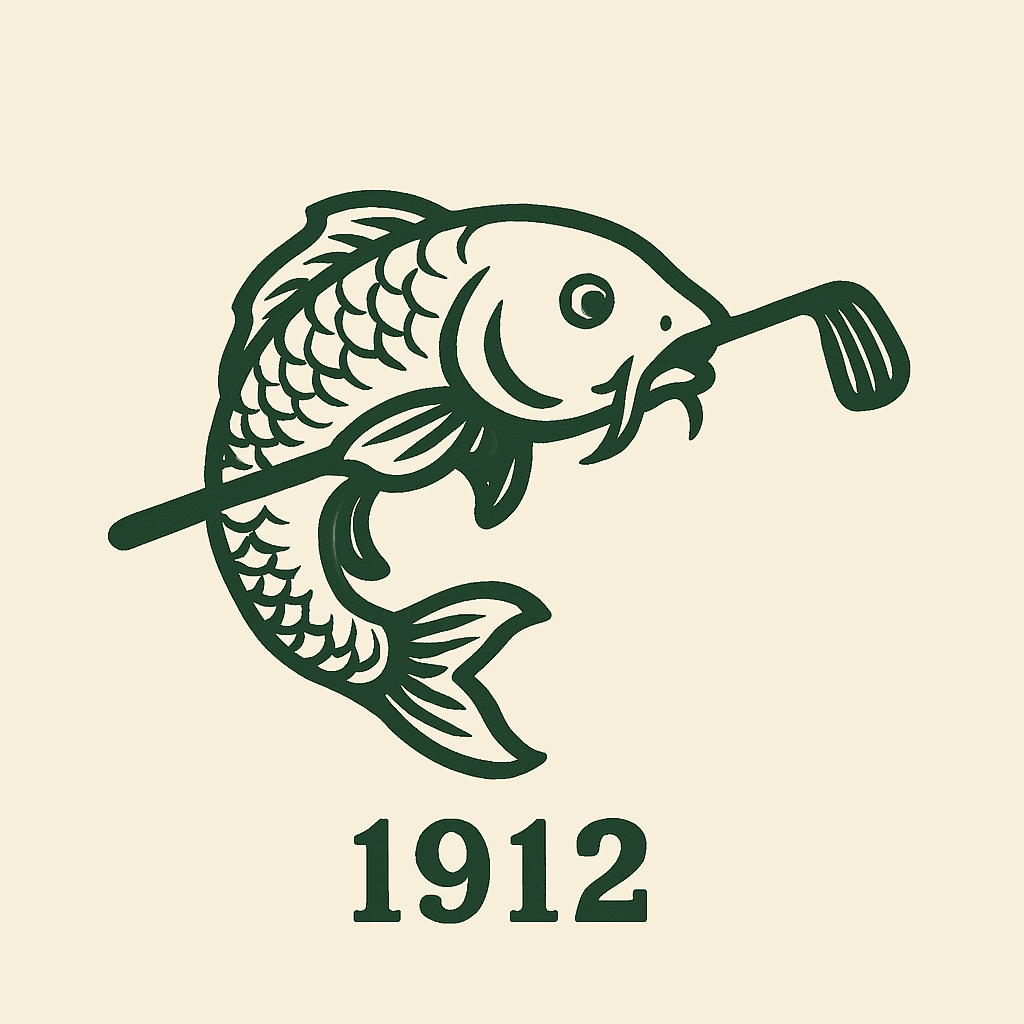
That may be why the alternate logo feels so right. It is not random. It is not forced. It feels discovered, as though it had been waiting all along inside the club’s story. The fish represents more than water. It represents memory. It represents mystery. It represents the kind of charm that old clubs cannot manufacture and new clubs cannot imitate.
So what is with the fish at Galen Hall?
Maybe it is a nod to the Moat Hole. Maybe it is a tribute to Tillinghast. Maybe it is the visual echo of a story that has floated around the club for more than a century. Or maybe it is simply proof that the greatest places in golf always leave room for wonder.
At Galen Hall, the fish has a name now.
Tilly.
And like every great legend, once you hear the story, you never quite look at the place the same way again.